
Concrete Block Wall Installation in
Warrensville Heights
Warrensville Heights Concrete Solutions builds concrete block walls for homeowners throughout Warrensville Heights and the surrounding area, delivering sturdy, professional results for privacy, structural, retaining, and boundary applications.
20+
Years Serving Warrensville Heights
450+
Concrete Jobs Done
4.9/5
Average Customer Rating
What Concrete Block Walls Are and Why Homeowners Choose Them
Concrete block walls, also known as concrete masonry unit or CMU walls, are one of the most durable and versatile structural solutions available for residential properties. Unlike wood fencing or poured concrete walls, concrete block construction allows for incredible flexibility in height, thickness, and configuration, making it suitable for a wide range of applications including privacy walls, retaining walls, boundary walls, structural walls for outbuildings and additions, and decorative garden or landscape walls.
Homeowners choose concrete block walls for several compelling reasons. They're exceptionally strong and resistant to impact, rot, insects, and fire in a way that wood simply cannot match. They hold up to Ohio's freeze thaw cycles far better than materials like wood or unreinforced brick when properly constructed with adequate mortar and reinforcement. They also provide meaningful noise reduction compared to open fencing, which makes them a popular choice for properties near busy roads, commercial areas, or neighbors whose outdoor activity generates noise throughout the day. A well built concrete block wall adds permanent, lasting value to a property and requires very little ongoing maintenance once it's in place.
When You Need a Concrete Block Wall and What Happens Without One
Concrete block walls are the right solution in a variety of situations. Homeowners looking for genuine privacy and security along a property boundary often find that wood fencing deteriorates too quickly and lacks the structural permanence they want, while a concrete block wall provides both visual privacy and a physical barrier that's genuinely difficult to breach and requires no repainting, restaining, or replacement of rotted sections every several years.
Retaining wall applications are another area where concrete block excels. When a yard has a significant grade change and soil needs to be held back to create a level usable area, the lateral pressure involved demands a wall material with real structural integrity. Wood timbers and landscape blocks can handle modest retaining applications, but for taller retaining walls or situations where significant soil load is involved, concrete block with proper reinforcement and drainage behind the wall is the appropriate and code compliant solution in most cases.
Properties near busy roads or commercial zones benefit from concrete block walls for noise attenuation, since the mass of a block wall absorbs and reflects sound in a way that lightweight fencing cannot. Homeowners who've tried wooden privacy fences in noisy locations often find the difference a solid masonry wall makes to their outdoor living environment is significant and immediately noticeable.
When Do You Need a Concrete Block Wall?
The most common reason homeowners install a concrete block wall is privacy. A well-built CMU wall along your property boundary gives you a solid, permanent barrier that no fence alternative can match for durability or longevity.
Concrete block walls are also installed to define property boundaries, create separation between neighboring properties, enclose a yard or pool area, support a raised garden or landscape bed, or serve as the structural walls of a garage, workshop, or home addition.
Delaying a wall installation when one is clearly needed has real costs. An unenclosed yard is harder to secure, less private, and less usable than it could be. Temporary fence solutions that are replaced every few years end up costing more over time than a single properly built CMU wall that lasts for decades.
How We Plan and Build Your Concrete Block Wall From the Ground Up
Every concrete block wall project begins with a careful assessment of the intended purpose, height, and location of the wall, since these factors determine the footing size, block thickness, reinforcement requirements, and any drainage provisions that need to be incorporated into the design. A wall that looks simple from the outside often involves more engineering consideration beneath the surface than most homeowners realize, particularly for retaining walls or taller privacy walls where the forces acting on the structure are significant.
We start by excavating and pouring a concrete footing below the frost line, sized appropriately for the height and load the wall will carry. Building below the frost line is critical in Northeast Ohio, since a footing that sits above the freeze depth will be subject to frost heave every winter, which gradually pushes the wall out of level and eventually causes structural failure regardless of how well the block work above it is done.
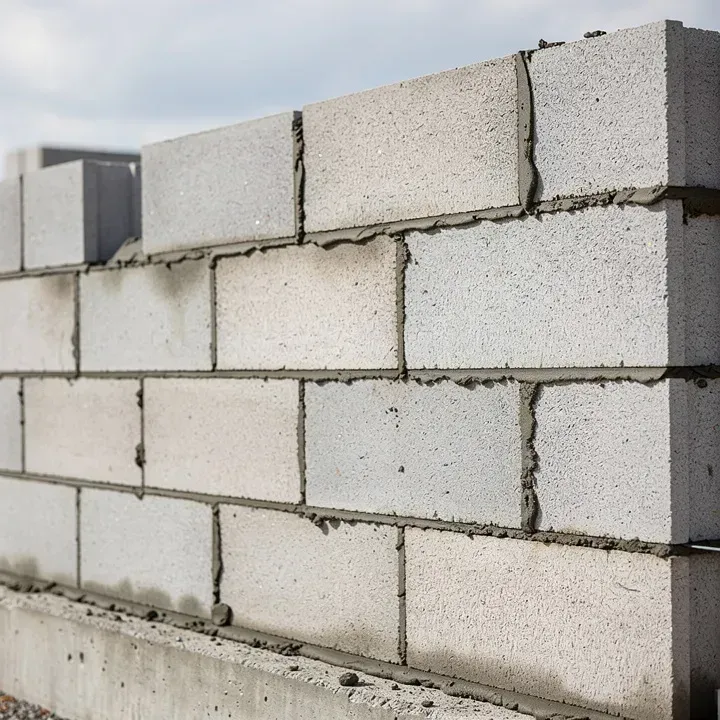
Once the footing has cured to adequate strength, block laying begins from the bottom course upward, with each course set in fresh mortar and checked for level and plumb continuously throughout the build. Vertical reinforcing steel is installed through the hollow cores of the blocks at specified intervals and grouted in place, providing the tensile strength the wall needs to resist lateral pressure from soil, wind, or impact. Horizontal reinforcement is added between courses where the wall height or loading requires it. For retaining walls, a drainage layer of gravel and a perforated drain pipe are installed behind the wall before backfilling to prevent hydrostatic pressure from building up behind the block and compromising the wall's structural integrity over time.
The top course is finished with cap blocks that protect the cores from water infiltration and give the wall a clean, finished appearance. Depending on your preference, the finished wall can be left in its natural gray block finish, painted, or coated with a masonry sealer to reduce moisture absorption and enhance longevity.
Understanding the Factors Behind Your Block Wall Estimate
Concrete block wall costs vary considerably depending on the wall's intended purpose, height, total linear footage, and the site conditions where it's being built. Height is one of the most significant cost drivers, since taller walls require deeper and wider footings, more material per linear foot, and additional reinforcement to safely handle the structural demands placed on them. A four foot decorative garden wall involves a very different scope of work than a six foot privacy wall or an eight foot retaining wall holding back a significant soil load.
Site accessibility and existing conditions on your property also affect the cost meaningfully. Walls being built in tight or difficult to access areas of a yard require more manual labor to move materials and work efficiently, while sites that require significant excavation or grading prior to footing installation add to the overall project scope. Retaining walls involving drainage system installation behind the wall add material and labor costs compared to a freestanding boundary or privacy wall on level ground.
The finish of the wall is another variable worth considering. A standard gray block finish is the most straightforward option, while painted or sealed finishes add a step to the process but can significantly enhance the wall's appearance and long term resistance to moisture and staining. We discuss every one of these factors openly during your estimate and provide a clear, detailed breakdown of what your specific wall project involves before any commitment is made.
Frequently Asked Questions
What types of concrete block walls do you build?
We build a full range of concrete block wall types for residential properties, including privacy walls along property lines, retaining walls to manage grade changes and hold back soil, boundary and perimeter walls, structural walls for garages and outbuildings, and decorative landscape or garden walls. Each wall type has its own design and construction requirements, and we assess every project individually to make sure the wall is built to handle the specific demands of its intended application, not just constructed to a generic standard.
Do concrete block walls require a permit?
Many concrete block wall projects do require a permit, particularly retaining walls above a certain height, walls that run along shared property lines, or walls that are part of a larger construction project like a garage or addition. Requirements vary depending on the wall's height, location on the property, and its intended structural purpose. We handle the permitting process on your behalf for projects that require one, so you don't have to navigate the building department, submittal requirements, or inspection scheduling on your own.
How long will a concrete block wall last, and does it need maintenance?
A properly built concrete block wall with adequate footings, correct reinforcement, and good drainage behind retaining walls can realistically last for several decades with very little maintenance required. The most common maintenance consideration is periodic inspection of the mortar joints, since mortar can weather and crack over time, particularly on walls with significant sun and moisture exposure. Repointing, which involves removing deteriorated mortar and replacing it with fresh material, is a straightforward maintenance task that can significantly extend the life of the wall when done before joint deterioration progresses too far. Applying a masonry sealer at installation and periodically thereafter also reduces moisture absorption and slows the weathering process considerably.
How tall can a concrete block wall be on a residential property?
Maximum wall height on residential properties is governed by local zoning ordinances and building codes rather than by the structural limits of the material itself, since concrete block can be engineered to reach significant heights when properly reinforced. In most residential zones, freestanding walls along property lines are limited to a certain height without a variance or special permit, and retaining walls above a certain height typically require engineered drawings and permit approval before construction can begin. We're familiar with the local requirements in this area and will confirm what applies to your specific property and wall type during the estimate visit.
Let's Talk About Your Concrete Project
If you've been putting off dealing with a cracked driveway, sunken sidewalk, or aging patio, now is a great time to get it taken care of. Reach out today for a free, no obligation estimate, and we'll walk you through your options honestly so you can make the right decision for your home and your budget. Call us, and let's get your concrete project started.


Contact
(216) 220-8148
Mon–Sat: 7am–7pm
Warrensville Heights, OH
About Us
Warrensville Heights Concrete Solutions is a locally owned and operated concrete contractor with over 20+ years of experience serving homeowners throughout Warrensville Heights and the surrounding Cleveland area. We're committed to honest pricing, quality craftsmanship, and concrete work built to handle everything Northeast Ohio weather can bring. We proudly serve homeowners across the wider region, not just within city limits.
© Copyright 2026 Warrensville Heights Concrete Solutions. All rights reserved.
© Copyright 2026 Warrensville Heights Concrete Solutions.
All rights reserved.